BIT Capital Investment Approach
Our investment approach is characterized by rigorous bottom-up stock selection and highly active portfolio management. The entire investment process is supported by proprietary data models, AI-driven signal generation, and real-time quantitative valuation models. The final decision is made by a human.

Jan Beckers
Founder & CIO
“Our goal is to understand companies just as well as the CEO does.”
Human x AI Investment Platform
[ Repeatable Alpha ]
The interplay of human analysis and technological decision support creates a consistent, reproducible process for targeted stock picking and highly active portfolio management.
Data and AI Models
[ AI DRIVEN ]
Fundamental investment hypotheses arise from a deep understanding of business models, competition, and technological innovation cycles. At the same time, our technology platform processes 80 terabytes of raw data every day, generates hundreds of near-real-time signals and insights per company, and runs more than 30 AI-supported processes with over 500 million tokens per month.
KPI-Forecasts
Proprietary forecasting models anticipate quarterly results before publication on the basis of individually curated datasets and quantitative signals. Key KPIs are continuously modeled for each core position and updated in real time.
AI Agent
An agentic AI system that accesses our full dataset, models, and external sources in real time and generates research outputs from them - from earnings analyses to financial models - thereby scaling the entire research process while leaving the investment team's decision-making authority unchanged.
Data-Machine
Every month, our Data Machine processes more than 2.4 petabytes of raw data from financial markets, consumer signals, and unstructured web sources. Proprietary models and agent-based AI systems transform this data into operating insights and quantitative signals in real time. More than 75% of all trades are now influenced by this systematic data infrastructure.
Alle gezeigten Visualisierungen dienen ausschließlich illustrativen Zwecken sowie der Veranschaulichung unserer Daten- und KI-Modelle. Sie basieren auf realen Use-Cases, technischen Prozessen und methodischen Ansätzen, bilden jedoch keine Echtdaten, reale Research-Ergebnisse oder Prognosen ab.
Risk Management
Integrated Risk Framework
Risk management is an integral part of our investment process. It ensures comprehensive risk oversight through continuous bottom-up risk analysis at the single-security level and a holistic top-down assessment at portfolio level.
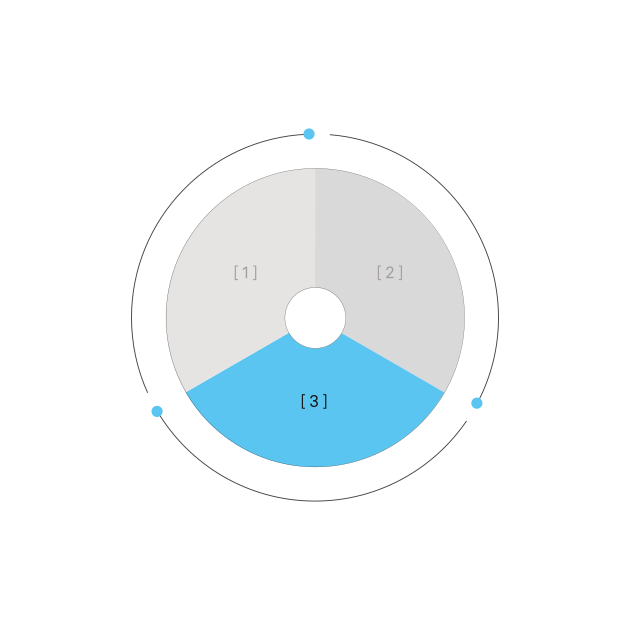
Bottom-up Timing & Sizing
[ KPI-Monitoring ]
Continuous KPI monitoring with alternative data at company level enables the identification of overvaluation and undervaluation situations on a daily basis, with immediate implications for sizing and timing. Positions are consistently adjusted or closed if expectations, the data situation, or valuation deteriorate.
[ Devils Advocate Sessions ]
For high-conviction positions with a NAV weighting of more than five percent, Devil's Advocate sessions are held: the lead analyst defends the thesis, while challenger and co-challenger present negative scenarios.
Top-down: Macro, Liquidity and Factor Management
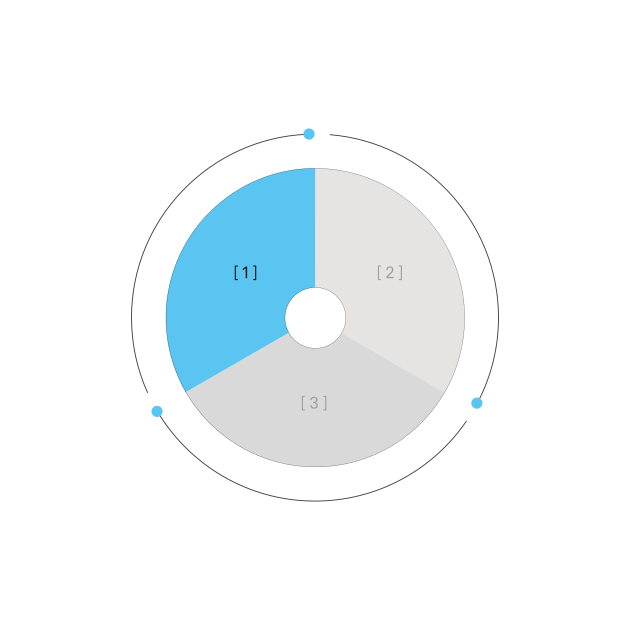
[ Macro Monitoring ]
A dedicated team, led by Marcel Oldenkott, systematically monitors macroeconomic regimes, liquidity, and market structure. This is supplemented by a proprietary five-factor risk model that quantifies sensitivities, concentrations, and drawdown risks at both single-stock and portfolio level. The portfolio is actively managed along these risk factors.
[ Hedging ]
Allocation adjustments are implemented selectively but consistently when structural risks change. The use of hedging instruments remains deliberately restrictive and is implemented only in clearly defined exceptional phases.
Governance
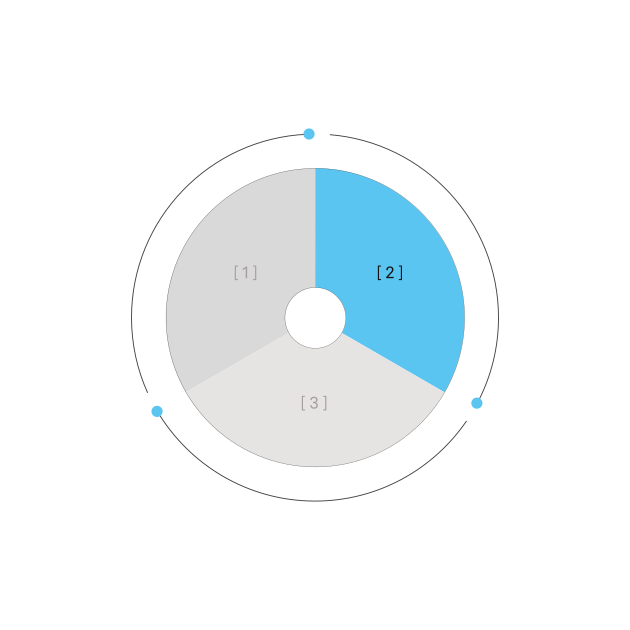
[ Risk Committee ]
An independent Risk Committee - consisting of the Chief Compliance Officer and senior operations managers deliberately outside the investment process - reviews monthly VaR metrics at fund and individual security level, liquidity profiles including stress scenarios, as well as risk contribution and risk driver analyses.
[ Ad hoc meetings ]
In the event of significant market movements or changes in the data situation, ad hoc meetings are convened to review and implement immediate measures. The organizational separation from the investment process ensures objective and disciplined risk assessment.